


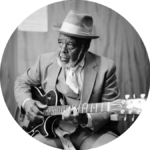
Henry Townsend, a key contributor to the St. Louis blues sound of the pre-World War era, enjoyed one of the longest careers in blues history. He recorded in every decade from the 1920s through the 2000s and was preparing to perform at a festival when he died on September 24, 2006, at the age of 96. A few months later he shared a posthumous GRAMMY Award for the album “Last of the Great Mississippi Delta Bluesmen: Live in Dallas,” recorded alongside fellow veterans Robert Lockwood, Honeyboy Edwards and Pinetop Perkins.
Townsend was not a Delta blues stylist, although he was born in the Delta town of Shelby on October 27, 1909. His family moved to other locales in Mississippi, Memphis, Caruthersvlle, Missouri, and Cairo, Illinois, where Townsend caught a freight train to St. Louis to avoid a beating from his father. Inspired in St. Louis by guitar icon Lonnie Johnson, Clifford Gibson, Henry Spaulding, and other local bluesmen, Townsend bought his first guitars. He found he had a gift not only as an instrumental virtuoso but also as a lyricist who could improvise new songs on the spot. On November 15, 1929, at the age 20, Townsend made his first records for Columbia.
Townsend made further records for Paramount, Victor and Bluebird in the 1930s and played on sessions by St. Louis-based artists Roosevelt Sykes, Walter Davis, Robert Lee McCoy (aka Robert Nighthawk), Big Joe Williams, and Pine Top Sparks, as well as Memphis Minnie on one outing to Chicago. He played guitar on—and said he wrote—the first-ever version of “Every Day I Have the Blues” by Sparks in 1935. He most frequently teamed with pianists Sykes or Davis in taverns and nightclubs, and also played with Robert Johnson, John Lee “Sonny Boy” Williamson and many others, while also working as a taxi driver. He learned piano from Sykes and in return taught Sykes some guitar. After serving in World War II he moved to Chicago and recorded for the Bullet label in 1948 but as public tastes in blues changed, he decided to find steady employment back in St. Louis as a hotel manager and then as an insurance collector. Whether as a musician or in other work, he was known for his thoughtful, businesslike, and uncompromising demeanor. He earned the nickname “Mule” for his stubborn, determined nature.
As researchers sought out older bluesmen in the 1960s, several of Townsend’s prewar recordings were reissued on LP and he began to record again. He recorded full albums for Prestige/Bluesville, Adelphi, Nighthawk, Swingmaster, Wolf, Blueberry Hill and APO and made appearances on several others. He performed at festivals and concerts in the U.S. and Europe playing guitar and piano, sometimes with his wife Vernell, and served as a mentor to young musicians in St. Louis. As a former Paramount recording artist, he was scheduled to highlight the inaugural Paramount Blues Festival in Grafton, Wisconsin, in 2006 but fell ill when he arrived and passed away in a hospital in nearby Mequon.
Townsend was awarded the National Endowment for the Arts’ National Heritage Fellowship in 1985 and was honored on the St. Louis Walk of Fame in 1995. His autobiography, “A Blues Life: Henry Townsend,” as told to Bill Greensmith, was published in 1999.