


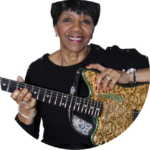
Barbara Lynn burst on the national scene as a 20-year-old ingenue in 1962 when her self-penned R&B ballad “You’ll Lose a Good Thing” peaked on Billboard magazine’s charts as No. 1 in R&B and No. 8 in pop. The rival Cash Box charts ranked it No. 2 R&B and No. 4 pop. Although it was her warm, appealing vocal style that was spotlighted on this and several subsequent hits, her act had another dimension that she could feature in her live performances—her talent as a left-handed electric guitarist. That gift, which helped win her a following among blues fans over the years, was exciting enough for her to be featured on an instrumental workout standing side by side with guitar virtuoso Gatemouth Brown on the syndicated TV program The !!!! Beat! In 1966.
Brown was one of her early favorites on guitar along with Guitar Slim, B.B. King, Jimmy Reed and a flamboyant showman from her hometown of Beaumont, Texas, named Curley Mays (Gatemouth’s nephew). But it was seeing Elvis Presley on TV that spurred her to take up the instrument. Her taste in female vocalists ranged from Etta James and Ruth Brown to Brenda Lee, Timi Yuro and Connie Francis. Born Barbara Linda Ozen on January 16, 1942, Lynn formed a high school band, Bobbie Lynn & the Idols. She learned guitar by watching and talking to Curley Mays, Clarence Garlow and Lonnie Brooks, then known as Guitar Jr. As a teenager she was already writing songs and performing in local clubs with bands including Clifton White & the Knights, the Bon-Ton Krazy Kats and the Twisters, billed as Barbara Lynn and her Left-Handed Guitar. Beaumont bluesman and DJ Clarence Garlow tried to get Goldband Records to sign her but the song she auditioned only surfaced decades later on a CD compilation.
Swamp pop singer Joe Barry introduced her to producer Huey P. Meaux, “the Crazy Cajun,” who recorded her for his Eric label before going national with Philadelphia-based Jamie Records and, later, Atlantic, in addition to releasing 45s on labels he owned. The success of “You’ll Lose a Good Thing,” one of her many songs about romantic relationships, led to national tours with her mother traveling with her, and the first of two appearances on American Bandstand. Meaux recorded her Jamie sessions at Cosimo Matassa’s J&M Recording Studio in New Orleans. Joe Barry’s band members played on several songs and a young Dr. John was a frequent participant. Twelve of her singles made the Billboard or Cash Box charts, and one, “Oh! Baby (We Got a Good Thing Goin’),” resulted in a phone call from Mick Jagger asking her permission to record it. The Rolling Stones’ version netted Lynn some welcome royalties, as did numerous covers of “You’ll Lose a Good Thing.”
In the 1970s Lynn took a step back from music to raise a family and moved to Los Angeles, although she still performed and recorded on occasion. She turned down several opportunities to perform overseas because of an aversion to flying, but in 1984 she did record a live album in Japan and another in England in 1999. Reissues in the U.S. and Europe spotlighted her early work while she recorded new albums for Ichiban, Bullseye Blues, I.T,P., Antone’s and Dialtone. Although she had signed away rights to a few of her hit songs, new royalties materialized from samples of “l’m a Good Woman” by Lil Wayne, Moby and others. Honors came her way with a Rhythm and Blues Foundation Pioneer Award, a National Heritage Fellowship, a Star of Texas Folklife Award and induction into the Museum of the Gulf Coast Music Hall of Fame. Back home in Beaumont the street where she lives is now named Barbara Lynn Street.