


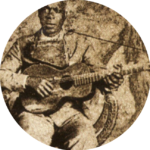
Henry “Ragtime Texas” Thomas was one of the first generation of Black songsters and blues performers to record, already in his fifties when he first went into the studio for the Vocalion label in 1927. His 1927-1929 recorded repertoire of 23 songs largely predated the blues and included reels, ballads, rags, spirituals, waltzes and minstrel songs, performed as dance music set to his rhythmic guitar picking and strumming and the unique melodies he played on pan-pipes made from cane.
Documented history on Thomas is scant, but Texas folklorist and historian Mack McCormick undertook dogged research efforts that led him to some Thomas cousins and to railroad employees who remembered him—a task complicated by the fact that in Thomas’ era there seemed to be a guitarist playing for tips at every depot. Thomas, an inveterate railroad traveler, made his living hoboing from town to town through Texas and beyond; he announced stops all the way to Chicago in “Railroadin’ Some.” According to relatives, Thomas came from the Big Sandy area of Upshur County, and his birthdate was recorded in a family bible as 1874. His parents had been slaves. McCormick suspected that a street singer he heard in Houston in 1949 might have been Thomas, but proof eluded him, and Thomas reportedly died around 1950.
Thomas never recorded again after 1929. But his sounds have lived on in reissue albums and in pop culture—in the music to Canned Heat’s 1968 hit “Going Up the Country” (borrowed from Thomas’ “Bull Doze Blues”) and as part of the background soundtrack in scenes of the 2023 film Killers of the Flower Moon, among other examples. Bob Dylan, the Lovin’ Spoonful, Taj Mahal, Dom Flemons and others have recorded his songs. Thomas is now recognized as an iconic figure in Americana, and as McCormick wrote, among all the early blues recording artists, “It is Henry Thomas who offers the deepest look at the roots of Black traditions.”