


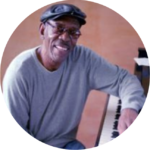
Rosco Gordon was a hitmaking blues headliner early in his career but retreated from public view to run a business and raise a family, only to re-emerge when he learned his historic early records had attracted a new generation of fans. Gordon’s hits, most notably “Booted,” “No More Doggin’,” and “Just a Little Bit,” made the Billboard charts sporadically from 1951 to 1960. He also influenced ska and reggae music when Jamaican musicians picked up the distinctive rhythm of his piano playing.
Memphis was Gordon’s birthplace, on April 10, 1928, although the family lived in the Mississippi Delta during some of his earliest years. Billy “Red” Love mentored him on piano and later led Gordon’s road band. Before he began recording at Sam Phillips’ studio in Memphis in 1951, he worked as a shoe shine boy and in a lumber mill. Phillips at first recorded him for RPM Records, then for Chess and a few years later for his own Sun label. To settle a conflict between RPM and Chess when “Booted” appeared in both labels and reached No. 1 on the R&B charts for RPM in 1952, rights to Gordon’s tracks went to RPM and in exchange Howlin’ Wolf became an exclusive Chess artist.
He was the first bluesman to record for Duke Records, followed by Johnny Ace, Bobby Bland and Earl Forest. Several of their releases bore the label credit “With the Beale Streeters,” a name also used in Duke’s publicity (and cited in Gordon’s obituaries). However, several different musicians played on these sessions and it was not a true band outside its various studio assemblages. In Gordon’s words, “There was no such animal as the Beale Streeters.” Gordon toured the country as a featured attraction or on big R&B package shows whenever his records hit the charts, working other jobs in between. His last year of extensive touring, on the strength of his Vee-Jay hit “Just a Litte Bit” was 1960. Blessed with a flair for comic novelty, Gordon once toured with a live chicken as part of his act after he recorded “The Chicken” for Sun, while his first hit was titled “Saddled the Cow (And Milked the Horse).”
Gordon, however, was frustrated at his lack of income from the record business. Problems with copyrights, the musicians’ union and legal proceedings all hampered his career. He moved from Shreveport, Louisiana, back to Memphis and then in 1962 to New York, where he and his wife, singer Barbara Kerr, raised three sons. Gordon did not stop writing songs or recording but he curtailed his personal appearances to work in his cleaning business, which he claimed to have won in a poker game. He recorded for ABC-Paramount and other companies and started his own Bab-Roc label to release 45s, but none of his later records enjoyed chart success. Reissues of his 1950s sides in England and a 1980 interview by Hank Davis in Living Blues magazine brought him to the attention of blues fans worldwide, and in the years to follow he played festivals and nightclubs and recorded albums for JSP, Stony Plain, Dualtone and the legendary reggae label Studio One. In May 2002 his appearance with B.B. King, Ike Turner and Little Milton at the W.C. Handy Awards was filmed for a documentary, The Road to Memphis. But Gordon did not live to see the program televised. He died of a heart attack in Queens, New York, on July 11, 2002.